
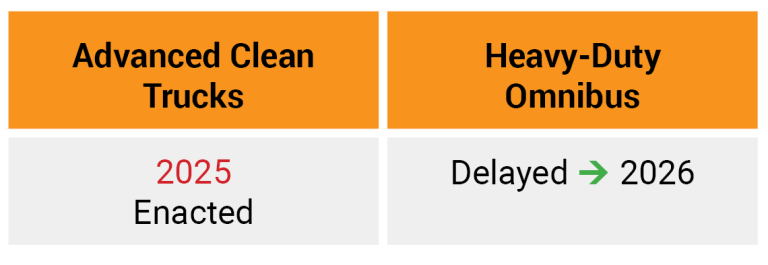
The State of New York enacted the Advanced Clean Trucks (ACT) in January 2025, but postponed the Omnibus regulations until 2026.
Since the California Air Resources Board adopted its medium and heavy-duty electric truck regulations, ten other states have voluntarily agreed to adopt California’s regulations. That was then, not now. Recognizing that the regulations are economically and technologically infeasible, several states have delayed enforcement, in whole or in part. New York, New Jersey, Oregon, and other states are proposing delays.
Representative Buttenschon has introduced Assembly Bill A10724, which would prohibit enforcement of the ACT rules until proper infrastructure is available.
Track the status of the bill here.
States can look to California to see that the regulations have not incentivized truck manufacturers to build electric trucks that meet a tow truck’s performance and safety standards, leading to an 80% decline in combustion truck sales in California in the first year of implementation. 2025 is starting out even worse. Tow truck operators and others are not able to upgrade older, higher emission trucks to the most modern, cleanest emission vehicles available.
If states want to avoid California’s massive decline in modern, lower emission engine sales, contact your elected leaders and warn them that the regulations threaten small businesses, jobs, and the motoring public.
You have a voice in the political process. Join us.
We use cookies to improve your experience on our site. By using our site, you consent to cookies.
Manage your cookie preferences below:
Essential cookies enable basic functions and are necessary for the proper function of the website.
These cookies are needed for adding comments on this website.
These cookies are used for managing login functionality on this website.
Statistics cookies collect information anonymously. This information helps us understand how visitors use our website.
Google Analytics is a powerful tool that tracks and analyzes website traffic for informed marketing decisions.
Service URL: policies.google.com (opens in a new window)
Marketing cookies are used to follow visitors to websites. The intention is to show ads that are relevant and engaging to the individual user.
A video-sharing platform for users to upload, view, and share videos across various genres and topics.
Service URL: www.youtube.com (opens in a new window)
You can find more information in our Cookie Policy and Privacy Policy.